 PII Redactor
Readable placeholders
Values become tokens such as {{EMAIL_1}} and {{PHONE_1}}, so the model can still reason about the message.
Private beta | n8n + LLM
PII Redactor is an n8n community node backed by a managed API. It detects six supported categories of structured data, replaces detected values with temporary placeholders, and lets your workflow restore those values after the LLM responds. Detection is deterministic and best effort, and the service performs reversible pseudonymization rather than complete anonymization.
Supported categories: email addresses, phone numbers, credit-card candidates, IP addresses, IBANs, and selected contextual national identifiers.
Beta access includes installation instructions, a managed HTTPS Base URL, a client-specific API key, synthetic workflow examples, and direct setup support.
PII Redactor performs temporary, reversible pseudonymization. It is not irreversible anonymization. The service stores a short-lived server-side mapping so supported values can be restored.

Replace supported PII with placeholders.
Process only the masked text.

Put the original values back once.
Contact ana@example.comSent to the LLMContact {{EMAIL_1}}These figures describe the current synthetic corpus and environment. They do not guarantee identical accuracy on every real-world input.
A safer handoff
LLMs are useful for support, forms, tickets, and internal automation, but the original input can contain information the model provider should never see. PII Redactor creates a short-lived mapping outside the LLM path. Your n8n workflow can then send the masked text to the LLM and restore the original values in the model response.
Values become tokens such as {{EMAIL_1}} and {{PHONE_1}}, so the model can still reason about the message.
The service temporarily stores the server-side mapping and metadata required to complete the matching Restore operation.
A successful Restore request consumes its mapping, even when the submitted text contains none of its known placeholders.
Each beta client receives a separate API key. Mappings and idempotency records are scoped to that client credential.
See it in n8n
This example shows how the community node fits into a basic n8n workflow. Your workflow owns the LLM call: PII Redactor only handles the Redact and Restore operations around it.
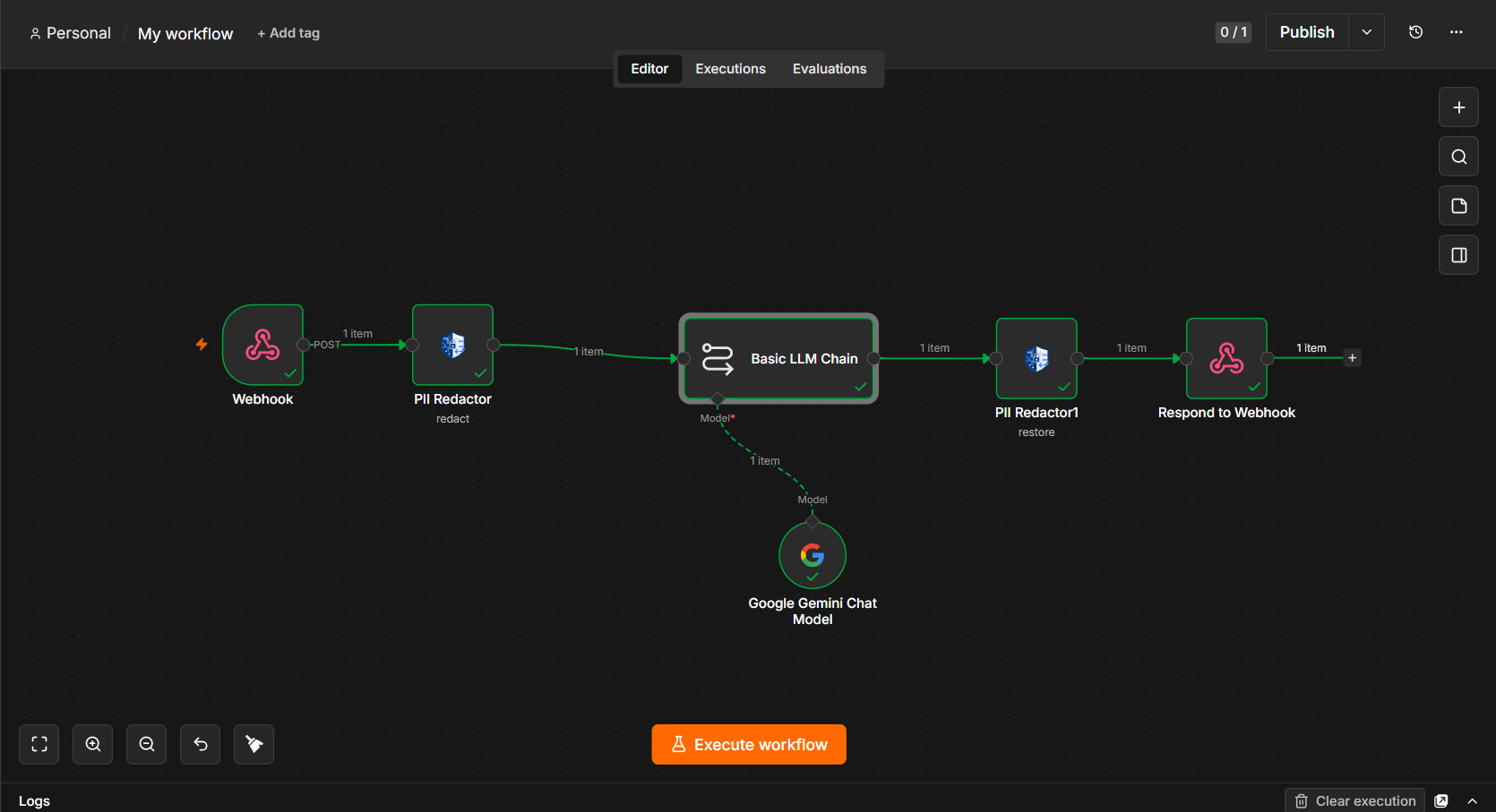
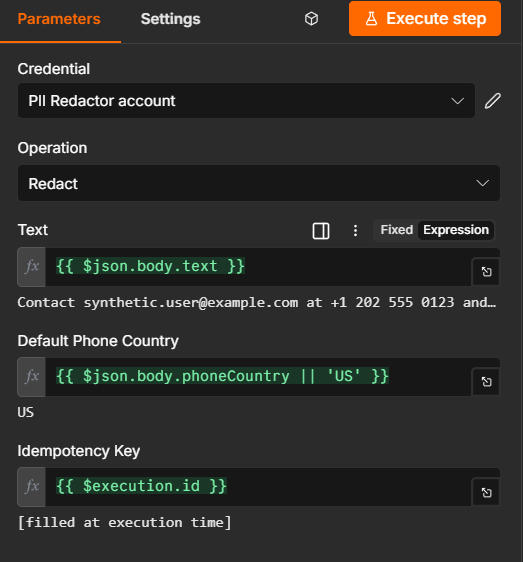
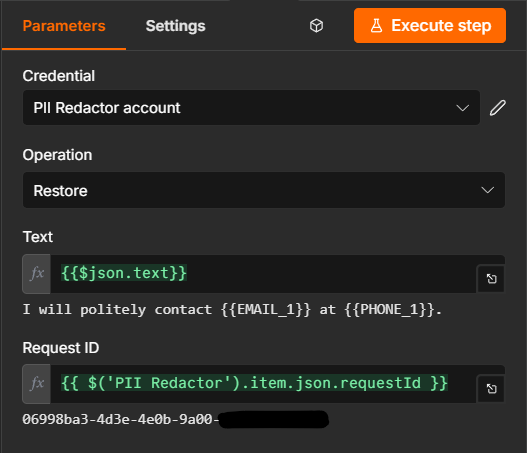
The screenshots use synthetic example values. Exact node fields may vary with your n8n and LLM node versions.
Get ready
PII Redactor is designed for self-hosted n8n instances that allow community nodes. Start with synthetic data while you build and verify the workflow.
n8n-nodes-pii-redactor package.n8n-nodes-pii-redactor@beta.For queue mode or manual community node installations, install the package in the n8n nodes directory.
npm install n8n-nodes-pii-redactor@betaRestart every n8n process that must load the node, including all required workers in queue mode. Manual installation requires Node.js 22 or later.
Credential
In n8n, create a credential of type PII Redactor API. Use the exact Base URL and API key assigned to your beta account.
| Field | Value | Rules |
|---|---|---|
| Base URL | The HTTPS URL supplied by the PII Redactor beta team | No path, query string, fragment, username, or password. |
| API Key | The key assigned to your beta account | Store it only in the n8n credential. |
https://the-api.example.comDo not append /v1/redact or /v1/restore. Remote URLs must use HTTPS.
Step 1 | Redact
Add a PII Redactor node before your LLM and select the Redact operation. Pass the exact string that may contain supported PII.
| Parameter | Purpose |
|---|---|
| Operation | Select Redact. |
| Text | The original text from the previous node. |
| Default Phone Country | Two-letter phone region code from the current phone-number metadata for local phone numbers. |
| Credential | Your PII Redactor API credential. |
Common expressions include:
{{$json.text}}
{{$json.body.text}}
Do not wrap a string expression in JSON.stringify(). The added quotes and escapes become part of the text.
Local phone numbers are supported for the countries and territories recognized by the current phone-number metadata. Set Default Phone Country to the region where the local number is valid.
International numbers beginning with + are interpreted from their calling code and normally do not depend on the selected default country.
., _, :, or -. Never reuse it with different text or a different phone country.The current beta accepts 245 two-letter metadata region codes. These include countries, territories, and special regional codes recognized by the phone-number library, so they should not be described as ISO 3166-1 countries.
AC AD AE AF AG AI AL AM AO AR AS AT AU AW AX AZ
BA BB BD BE BF BG BH BI BJ BL BM BN BO BQ BR BS BT BW BY BZ
CA CC CD CF CG CH CI CK CL CM CN CO CR CU CV CW CX CY CZ
DE DJ DK DM DO DZ
EC EE EG EH ER ES ET
FI FJ FK FM FO FR
GA GB GD GE GF GG GH GI GL GM GN GP GQ GR GT GU GW GY
HK HN HR HT HU
ID IE IL IM IN IO IQ IR IS IT JE JM JO JP
KE KG KH KI KM KN KP KR KW KY KZ
LA LB LC LI LK LR LS LT LU LV LY
MA MC MD ME MF MG MH MK ML MM MN MO MP MQ MR MS MT MU MV MW MX MY MZ
NA NC NE NF NG NI NL NO NP NR NU NZ OM
PA PE PF PG PH PK PL PM PR PS PT PW PY QA
RE RO RS RU RW SA SB SC SD SE SG SH SI SJ SK SL SM SN SO SR SS ST SV SX SY SZ
TA TC TD TG TH TJ TK TL TM TN TO TR TT TV TW TZ UA UG US UY UZ VA VC VE VG VI VN VU
WF WS XK YE YT ZA ZM ZW
Phone detection validates number structure, not ownership, assignment, availability, or whether the number is currently active. To reduce false positives, phone-like numbers following labels such as order, invoice, tracking, booking, reference, document ID, SSN, DNI, CPF, CURP, or similar contexts may be excluded.
{
  "requestId": "550e8400-e29b-41d4-a716-446655440000",
  "maskedText": "Contact {{EMAIL_1}} at {{PHONE_1}}",
  "entitiesFound": { "EMAIL": 1, "PHONE": 1 },
  "phoneCountry": "US",
  "expiresIn": 900
}| Field | Meaning |
|---|---|
requestId | Required by the matching Restore operation. |
maskedText | The only version of the input to send to the LLM. |
entitiesFound | Counts by type, never detected values. |
phoneCountry | Country used for local phone parsing. |
expiresIn | Lifetime assigned when the original Redact request was created. |
The API never returns the PII mapping to n8n. It returns only the masked text, metadata, and request identifier.
Step 2 | LLM
maskedTextConfigure the LLM user message with the Redact output:
{{$json.maskedText}}Never use the original webhook body, the original text field, or another upstream field that still contains the unmasked input.
The text may contain privacy placeholders such as {{EMAIL_1}} or {{PHONE_1}}. Preserve every placeholder exactly. Do not translate, rename, split, combine, duplicate, or invent placeholders.
Workflow metadata
requestIdSome LLM nodes replace their input JSON with a new output structure. Do not assume the Redact metadata remains available automatically.
Copy requestId into a field that travels with the LLM item.
Merge Redact metadata with the LLM response before Restore.
Reference the Redact node directly when the item relationship is preserved.
{{$('PII Redactor - Redact').item.json.requestId}}Adjust the node name if necessary. Test with synthetic data and confirm the value belongs to the same item and Redact operation.
Step 3 | Restore
Add a second PII Redactor node after the LLM. Select Restore, provide the model's response as a string, and pass the matching requestId.
| Parameter | Purpose | Examples |
|---|---|---|
| Operation | Select Restore. | - |
| Text | The textual response produced by the LLM. | {{$json.text}}, {{$json.output}} |
| Request ID | The ID returned by the matching Redact operation. | {{$json.requestId}} |
| Credential | The same client credential used for Redact. | PII Redactor API |
Other LLM nodes may use fields such as {{$json.message.content}}. Choose the field containing the actual response string, not the complete response object.
{
  "requestId": "550e8400-e29b-41d4-a716-446655440000",
  "restoredText": "Contact user@example.com at +1 415 555 0132"
}restoredText and selected application fields. Do not return credentials, internal configuration, or complete execution data.Important lifecycle rules
The default mapping lifetime is 900 seconds. expiresIn reports the lifetime assigned when the original Redact request was created. Replaying an idempotent request does not renew or restart that lifetime.
Verify the LLM output before calling Restore. Every successful Restore request consumes the mapping, even when the submitted text contains none of its known placeholders.
A second Restore, an expired mapping, or a mapping removed during maintenance returns not found.
If Restore returns 404, restart the complete cycle from Redact. The mapping cannot be reconstructed.
Placeholder contract
Placeholders are deliberately readable and exact. They let the model work with the structure of a message without exposing the underlying value.
{{EMAIL_1}}{{PHONE_1}}{{CREDIT_CARD_1}}
{{IP_ADDRESS_1}}{{IBAN_1}}{{NATIONAL_ID_1}}
Exact known placeholders are restored.
Modified placeholders remain unchanged.
Missing placeholders reveal no original value. Restore does not treat a missing placeholder as an API error.
Duplicated restorable placeholders are rejected before the mapping is consumed.
Unknown placeholders are not replaced with PII.
Placeholder counters are independent for each entity type. Repeated occurrences receive separate placeholders. Placeholders may be reordered by the LLM and still be restored if each known placeholder remains exact and appears no more than once. All supported national identifiers use the generic NATIONAL_ID placeholder; the public Redact response reports the entity count but does not expose the country or document type.
Failure handling
Use the HTTP status and sanitized node output to decide what happens next. Do not retry unchanged invalid input.
| HTTP | Meaning | Recommended action |
|---|---|---|
| 400 | Invalid input, country, request ID, or duplicated placeholder. | Correct the workflow input. Do not retry unchanged data. |
| 401 | Missing, invalid, or revoked API key. | Check the n8n credential and contact the PII Redactor beta team. |
| 404 | Mapping expired, consumed, unavailable, or owned by another credential. | Restart the complete cycle from Redact. |
| 409 | Idempotency request still in progress. | Retry with backoff using the same key and exactly the same payload. |
| 409 | The idempotency key was already used with different text or a different phone country. | Do not retry with that key. Correct the workflow and use a new stable key. |
| 413 | Payload exceeds the service limit. | Reduce the input size. |
| 429 | Client rate limit reached. | Retry with exponential backoff and jitter. |
| 500 | Internal service error. | Use a limited retry; contact the PII Redactor beta team if it continues. |
| 503 | The service readiness endpoint reports a dependency as unavailable. | Wait and contact the beta provider if availability does not recover. |
Current coverage
Detection is deterministic and best effort. The service processes only the text explicitly passed to the Redact operation. It does not inspect attachments, binary files, images, PDFs, audio, workflow metadata, credentials, headers, or other n8n fields automatically.
ASCII email local parts with valid registrable public domains. Internationalized and punycode domains are supported. SMTPUTF8 local parts, quoted local parts, address literals, local-only domains, and malformed or non-public domains are not supported.
ana@example.comSupported: user@xn--bcher-kva.exampleNot supported: josé@example.comNot supported: "john.doe"@example.comNot supported: user@localhostA valid domain does not prove that the mailbox exists.
Valid international and local phone numbers, including extensions, for the countries and territories recognized by the current phone-number metadata. International numbers beginning with + are interpreted from their calling code.
Phone detection validates structure, not ownership, assignment, availability, or whether a number is currently active.
Candidates containing 13-19 digits, optionally separated by spaces or hyphens, that pass the Luhn checksum.
The detector does not verify network, issuer, account existence, ownership, status, expiry date, or CVV. An unrelated number that passes Luhn may be a false positive.
Syntactically valid IPv4 and IPv6 addresses, including compressed IPv6, IPv4-mapped IPv6, zone identifiers, private ranges, special ranges, loopback addresses, and valid CIDR notation.
Syntax validation does not determine whether an address is public, active, reachable, assigned, or associated with a person.
IBAN candidates must use a country or territory supported by the current IBAN registry, match the expected country length, and pass structural and checksum validation. Spaces and hyphens are accepted as separators.
A valid checksum does not prove that the account exists, is active, or belongs to a specific person.
Only the specific contextual identifier types listed below are supported. A bare number is intentionally not classified as a national identifier.
Support for a country does not mean every identity, tax, passport, residence, or driving document from that country is supported.
National identifiers are detected only when accompanied by a supported contextual label. Support for a country does not mean that every identity, tax, passport, residence, or driving document from that country is supported.
| Country | Supported identifier |
|---|---|
| Argentina | DNI |
| Australia | TFN |
| Brazil | CPF |
| Canada | SIN / NAS |
| Chile | RUN and personal RUT context |
| China | Resident Identity Number |
| Colombia | Cédula de ciudadanía |
| France | NIR |
| Germany | Steuer-ID |
| India | Aadhaar |
| Italy | Codice Fiscale |
| Japan | My Number |
| Mexico | CURP |
| Poland | PESEL |
| South Africa | South African ID |
| Spain | DNI / NIE |
| United Kingdom | NINO |
| United States | SSN |
All supported national identifiers use the generic {{NATIONAL_ID_1}} placeholder. The public Redact response reports the entity count but does not expose the country or document type. The current beta does not announce every class of Spanish NIF; use the listed DNI / NIE scope.
The current version of the IBAN registry contains 124 supported country or territory codes.
AD AE AL AO AT AX AZ BA BE BF BG BH BI BJ BL BR BY
CF CG CH CI CM CR CV CY CZ DE DJ DK DO DZ EE EG ES
FI FK FO FR GA GB GE GF GI GL GP GQ GR GT GW HN HR HU
IE IL IQ IR IS IT JO KM KW KZ LB LC LI LT LU LV LY MA MC MD ME MF MG MK ML MN MQ MR MT MU MZ NC NE NI
NL NO OM PF PK PL PM PS PT QA RE RO RS RU SA SC SD SE SI SK SM SN SO ST SV TD TF TG TL TN TR UA VA VG WF XK YE YTPrivacy and operations
PII Redactor reduces the structured PII sent in the selected LLM text field. It does not protect unsupported entities, missed detections, other node fields, attachments, memory, tools, traces, logs, execution history, error workflows, or external observability systems.
The service temporarily stores the server-side mapping and metadata required to complete the matching Restore operation. The default mapping lifetime is 900 seconds.
The API does not return the mapping or detected values to the node. It returns counts and the masked text.
Pending mappings are stored in Redis and are not encrypted at the application layer. Access is protected through infrastructure controls, tenant-scoped keys, HTTPS, and network restrictions.
Each beta client receives a separate API key. Mappings and idempotency records are scoped to that client credential, with rate limiting per client.
Data handling and hosting
The API does not permanently store your workflow text, LLM responses, or detected PII values. It uses an Azure-hosted instance in the Americas and temporarily keeps only the server-side mapping and metadata required to complete the matching Restore operation.
Current beta service instance: Americas region. Contact the team for deployment and hosting details.
Pending mappings and idempotency metadata expire according to the current service configuration and are consumed or removed during the workflow lifecycle.
Current beta limits
These operational limits describe the current beta deployment and may change after the beta. Confirm current limits with the beta team before production planning.
Maximum JavaScript characters passed as Redact text.
Maximum complete JSON request body.
Returned lifetime is assigned when the original Redact request is created.
Current limit per beta client.
Restore is one-time and non-idempotent.
The current beta does not support horizontal API scaling.
Restarting or clearing Redis removes pending mappings.
Node.js 22 or later is required for manual installation.
Troubleshooting
Confirm the package appears under Settings > Community Nodes, restart n8n, and install it on every required process in queue mode. Confirm the runtime uses a supported Node.js version.
Confirm the PII Redactor beta team supplied the Base URL and key. Remove accidental spaces or line breaks, check whether the key was rotated or revoked, and never post it in a support request.
Pass the string field directly. Do not call JSON.stringify() around the n8n expression.
Set Default Phone Country to the country where the local format is valid. Use the international + form when possible.
The mapping expired, was consumed, was removed during maintenance, or belongs to another credential. Restart from Redact.
Confirm the LLM preserved exact spelling and braces, Restore received a string, the matching requestId was used, and the mapping had not expired.
Safe support requests
Never send real PII, API keys, complete request bodies, mapping contents, or full execution logs.
requestId only when requested and permitted by your support policyPackage version: 0.4.0-beta.1
Operation: Redact
Country: CO
Synthetic text: "Call [CO_LOCAL_PHONE]"
Expected: PHONE placeholder
Actual: No entity detectedFAQ
It should receive only maskedText. The operator is responsible for ensuring optional LLM fields, memory, tools, traces, prompts, and logs do not receive the original input.
No. It covers specific structured entities. Names, postal addresses, organizations, OCR, and every possible format are outside the current scope.
A modified placeholder cannot be restored. Use a system instruction that requires exact preservation and discard or restart the cycle if the response is unsafe.
No. A successful Restore consumes the mapping. A second request returns 404, so a new Redact cycle is required.
Do not blindly retry. The first request may have succeeded and consumed the mapping. Check the workflow state and restart from Redact if the mapping is no longer available.
Build and test with synthetic or controlled data first. Review n8n execution retention and your internal privacy requirements before processing real information.
Private beta
We are looking for a small number of teams already using self-hosted n8n and LLMs for support, forms, tickets, or internal processes.
Include the automation type, entities you expect to detect, and whether your n8n instance is self-hosted.
Contact the beta team Do not send real PII or API keys by email. Use synthetic or manually redacted examples.